
Resilience, recovery and investment: the strength of Ukraine’s private sector
In this interview, Andrii Nosok of Dragon Capital explains how access to long-term capital can help turn that resilience into sustainable recovery and unlock Ukraine’s economic potential.
17-08-2026

More than four years into the full-scale war, Ukraine’s private sector continues to demonstrate remarkable resilience. Businesses are operating under extraordinary pressure, yet they continue to adapt, invest and grow. Their determination is essential. Not only for sustaining the economy today, but also for laying the foundations for the country’s future recovery. Supporting this resilience is one of the reasons why BIO invested in the Rebuild Ukraine Fund (REBUF) - a private equity fund managed by Dragon Capital that aims to mobilise up to USD 250 million for Ukrainian businesses. REBUF is designed to provide companies with the long-term capital and strategic support they need to navigate wartime challenges and unlock growth opportunities.
To better understand the realities Ukrainian businesses face and how private capital can support them, we spoke with Andrii Nosok, Head of Private Equity and REBUF Fund manager at Dragon Capital.
The Ukrainian private sector during wartime
How would you describe Ukraine’s private sector today? Andrii Nosok: “Nearly four and a half years into the full-scale war, Ukraine’s private sector remains remarkably resilient. Businesses continue to operate in a hugely difficult environment shaped by security risks, labour shortages, logistics disruptions and damaged assets. More recently, frequent attacks on commercial real estate and warehousing facilities have significantly increased, thus reducing storage capacity in and around Kyiv as well as elsewhere in the country. Despite these difficulties, many companies not only continue to operate, but they also adapt and grow. Ukrainian entrepreneurs continue to invest in their businesses, pursue opportunities and contribute to the country’s resilience through economic activity and tax revenues. Anyone visiting Ukraine today can see companies continuing to operate, export, reinvest and grow. Recovery is not a distant post-war scenario. It is already happening."
Notwithstanding the resilience of Ukrainian entrepreneurs, they face two major challenges to keep their businesses running: access to energy and access to capital. Ukraine’s energy challenge is well documented. Repeated attacks on critical infrastructure have made energy security one of the country’s most urgent priorities and a central component of Ukraine’s recovery agenda. BIO is already contributing to address this challenge through direct investments in energy provision, and Dragon Capital set up dedicated infrastructure and energy investment vehicles. But what about access to capital?

This strong support from international partners reflects confidence in Ukraine's private sector and allows us to further mobilize capital for Ukrainian businesses operating under extraordinary conditions and driving the country's economic resilience today.
Andrii Nosok, Head of Private Equity at Dragon Capital
Andrii Nosok: “One of the key constraints for Ukrainian businesses today is access to capital. For it is important to realize that even though the war continues to weigh on the economy, several sectors are demonstrating resilience, including consumer goods and services, healthcare, pharmaceuticals, financial services, agriculture-related businesses, building materials, retail and technology. Some have adapted successfully to wartime conditions, while others are benefiting from reconstruction demand and urgent domestic needs. For many companies in these sectors, the challenge is therefore not a lack of customers or market opportunities as they want to expand production, replace damaged assets, invest in backup energy systems, strengthen storage facilities or enter new markets.
What often prevents them from doing so is a shortage of long-term investment capital. While access to debt financing has improved significantly in recent years thanks to support from international financial institutions and development finance institutions, access to equity capital remains limited. This is particularly challenging for SMEs, which are key employers in Ukraine. Their smaller scale, limited financial buffers and constrained access to financing make it harder for them to absorb shocks, invest in resilience and realise their growth potential."
REBUF
This is one of the main reasons why you established REBUF, aiming to provide USD 250 million in long-term capital to finance businesses that have demonstrated resilience. What makes REBUF different? Andrii Nosok: “Unlike traditional lenders, REBUF does not only provide financing. It combines equity capital with active ownership, strategic guidance and hands-on support. Dragon Capital targets majority or significant minority stakes in businesses with strong market positions and ambitious owners who are looking to grow despite the challenging environment. This combination of capital and expertise differentiates REBUF from many other financing options available in the market."
And how does this 'beyond capital' support become concrete? What can investees expect? Andrii Nosok: “REBUF acts as a transformational investor focused on post-war-shock recovery and growth. Beyond financing, the fund works with portfolio companies to strengthen corporate governance, institutionalise management practices, improve access to debt financing, support operational improvements and refine growth strategies. It also brings a strong environmental, social and impact agenda to its investments. The objective is not simply to help companies manage today’s challenges, but to help them become stronger, more transparent and more bankable over the long term."
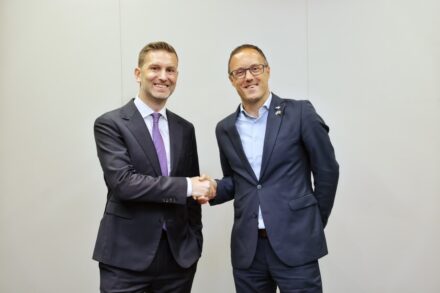
Andrii Nosok, Head of Private Equity at Dragon Capital (left) and Joris Totté, CEO of BIO at the signing ceremony of the USD 6M investment in REBUF.
Attracting more private investment
To conclude, in your opinion what would be needed to unlock even more private investment in Ukraine and what would your message be to international investors who are still hesitant to invest in Ukraine? Andrii Nosok: “Investors need stronger risk-sharing mechanisms. War-risk insurance, guarantees, blended finance solutions, concessional capital and continued support from DFIs and IFIs all play an important role in helping investors manage wartime risks. At the same time, predictable regulation, transparent governance, bankable projects and reliable local partners remain essential to attract long-term private capital. This might be challenging in Ukraine which is without a doubt a difficult market. However, the country is also set to become one of Europe’s largest recovery stories and a multi-decade investment opportunity. The country’s path towards EU membership and the reforms that come with it continue despite the war and are expected to strengthen investor interest over time. Those who enter now, with the right partners and a disciplined approach to risk, have an opportunity to not only support Ukraine’s recovery, but also to participate in the value that will be created along the way."
Read our most recent impact stories
From urgency to impact: how renewable energy is transforming communities in Nicaragua
24-09-2026
We spoke with Rodrigo Mantica from IHC about the origins of this journey, the partnership with BIO, and the future of renewable energy in Central America

